29G, 30G, 31G: How to Actually Pick a Needle Gauge
Why the number on the box is backwards, why thinner isn't always better, and why 30G became the default for self-injection. A practical guide to picking the right needle.
By Angel Trutschler
Director, meeco Servicios Globales S.L.
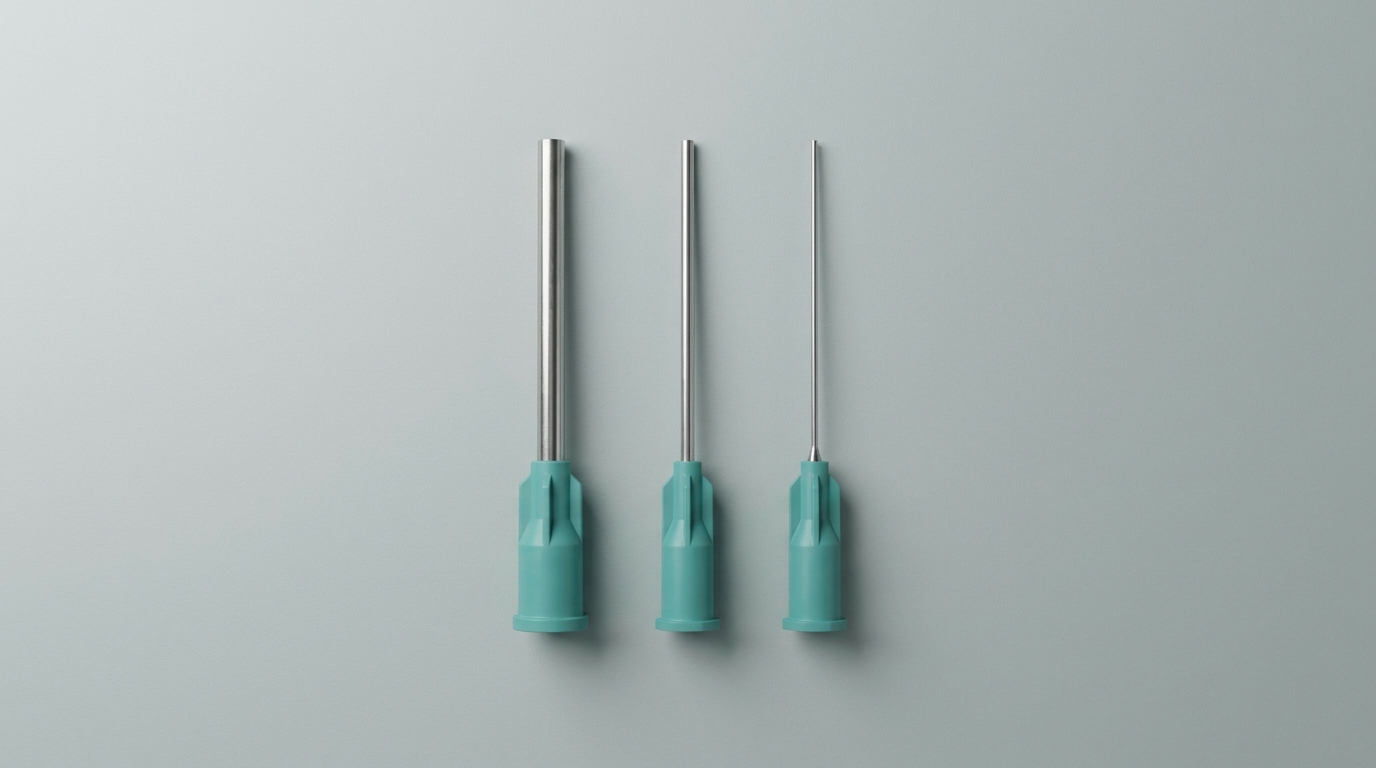
The number on an insulin syringe that says "30G" is the gauge — the thickness of the needle. And the scale is backwards: higher number means thinner needle. A 31G is thinner than a 30G is thinner than a 29G is thinner than a 27G.
This is one of those things you either already know and don't need this post, or you learned about five minutes ago and are now staring at a box wondering whether to upgrade. The short answer: 30G is the default for a reason, and unless you have a specific reason to move, don't.
Here's the longer version.
What gauge actually means
Gauge is based on an old wire-manufacturing scale (Stubs / Birmingham Gauge) and measures the outer diameter of the needle tube. At 30G, the outer diameter is about 0.31mm. At 31G, it drops to about 0.26mm. At 29G, it's up at 0.34mm. These are hair-thin differences — a 30G needle is roughly the thickness of four human hairs.
The inner bore (lumen) scales with the outer diameter, and the lumen is what determines how fast liquid flows through the needle.
Why thinner isn't always better
"Thinner = less pain" is roughly true, but the relationship flattens out fast at the high end. The pain difference between a 27G and a 30G is noticeable. The pain difference between a 30G and a 31G is in the noise for most people — it comes down to technique and hydration more than half a tenth of a millimetre of steel.
What does change noticeably with a thinner needle:
- Draw time. A 31G takes longer to draw viscous liquid. If you're pulling a thick reconstituted solution, a 31G can be frustrating.
- Bendability. 31G needles can flex if you push them into tough skin or hit connective tissue. A fast, confident stick fixes this. A hesitant stick doesn't.
- Clogging risk. Smaller bore = easier to clog if the solution has any particulate, or if the needle contacts the vial stopper's rubber core (coring).
For most subcutaneous self-injections with a thin aqueous solution, 30G is the sweet spot: thin enough that pain is minimal, thick enough that draws are fast and clogs are rare.
Why length matters more than gauge
The length of the needle determines what tissue layer you end up in.
- 4mm: too short for most abdominal fat in adults over 80kg. Works for children, very lean adults.
- 6mm: the default for adult subcutaneous injection. Reaches fat without reaching muscle, even on lean users.
- 8mm: old-standard "long" insulin needle. Slightly deeper subcutaneous reach but no real benefit over 6mm for most people, and increased intramuscular-stick risk in lean users.
- 12mm+: intramuscular territory. Not a subcutaneous tool.
For subcutaneous delivery, 6mm has been the evidence-backed standard for about a decade. Multiple diabetes societies revised their guidance away from 8mm and 12mm years ago.
30G vs 29G: when to go up
Some reasons to use a 29G instead of a 30G:
- Viscous solutions. If you're drawing something thicker than water and a 30G takes forever, 29G is justified.
- Thick rubber stoppers. A 29G is less likely to bend against a hard stopper.
- Coring concerns. Coring is when a tiny fragment of rubber gets pushed into the vial from the stopper. It's more likely with small-gauge needles on multi-puncture vials. A 29G reduces the risk slightly.
30G vs 31G: when to go down
Few.
Honest answer: the only real reason to use a 31G over a 30G is that you're extremely needle-phobic and the small theoretical pain reduction gives you the confidence to actually do the injection. That's a valid reason on its own. But don't pretend it's technically superior — at that gauge, technique matters more than the number.
What to buy
For almost everyone doing subcutaneous self-injection with a small, aqueous volume:
- 30G × 6mm, U-100 insulin syringe, 0.5ml or 1ml barrel. This is the default for a reason.
For specific edge cases:
- Small draws (under 30 units): 0.3ml barrel. The markings are larger and easier to read at small volumes.
- Viscous solutions or thick stoppers: 29G × 6mm.
- Needle phobia where it's a dealbreaker: 31G. Understand the tradeoff.
The shortlist
- Higher number = thinner needle. Backwards. Yes.
- 30G × 6mm is the self-injection default.
- Don't upgrade to 31G unless you have a specific reason. Usually you don't.
- Needle length affects which tissue you hit. Gauge affects how much it hurts and how fast you can draw. Don't confuse them.
InjectKit carries 30G × 6mm insulin syringes in pack sizes from 10 to 1000. Start here.
Get your supplies
CE-marked syringes, alcohol prep pads, and bacteriostatic water. Shipped from Spain to all EU countries.