How to Inject Properly: The Stuff Nobody Tells You Until Something Goes Wrong
A no-nonsense guide to subcutaneous self-injection — from sterile prep to site rotation to what a good stick actually feels like. Written for the moment something weird happens.
By Angel Trutschler
Director, meeco Servicios Globales S.L.
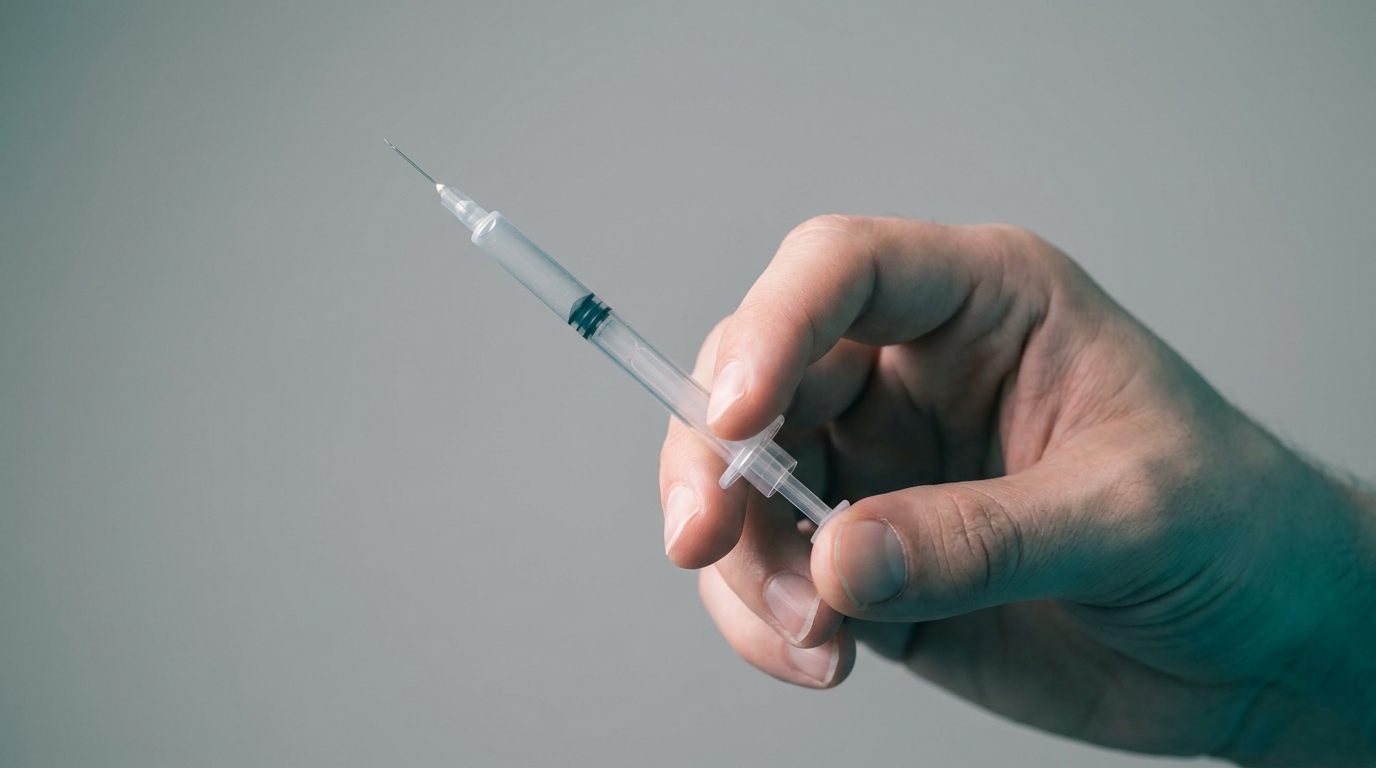
Most self-injection guides read like they were translated from a hospital pamphlet. You end up memorising the five steps, standing in your bathroom at 8am, and then something happens that the pamphlet didn't mention — a drop of blood, a bruise, a sting that feels wrong — and you're googling at 8:03am.
This is that guide, but written for the moment something weird happens.
Before you even open the box
The most common reason injections go sideways isn't technique. It's a box of pads that's been sitting on the bathroom shelf for six months with the foil pouches half-open, or a vial that got left on the counter overnight, or a syringe whose packaging has a pinhole you didn't notice.
Two habits that solve 90% of this:
- Check the pouch before you tear it. The foil should be taut, not puckered. If you can see the pad is dry or the foil is wrinkled, bin it. A cent's worth of pad is not worth a skin infection.
- Look at the vial, not the label. Particles, cloudiness, colour change, crystals on the stopper — any of these and you're done with that vial. This isn't paranoia. Standard pharmacology practice lists visual inspection as step zero.
If you keep supplies in a bathroom, move them. Bathrooms are the worst place to store anything sterile — humidity plus heat swings plus aerosolised soap. A closed drawer in a bedroom is better than the best bathroom cabinet.
Wash your hands like you mean it
Twenty seconds, warm water, soap, between the fingers, under the nails. Not a rinse, not a splash. This is the single step where the gap between "done properly" and "done quickly" actually shows up as an infection rate.
If you can't wash, an alcohol hand rub is the fallback — but it's a fallback, not a substitute. Soap mechanically removes dirt. Alcohol doesn't.
The pad is not a wipe
The alcohol pad has one job: leave a thin film of 70% isopropyl on the skin and let it dry.
- 70%, not 99%. Higher isn't better. 70% actually kills more bacteria because the water helps the alcohol penetrate the cell wall.
- One pad per site, one direction. Start at the intended injection point and spiral outwards. Don't go back over the same spot.
- Let it dry. If you inject while it's still wet, the alcohol stings on the way in and you think you did something wrong. You didn't — you just didn't wait.
Thirty seconds of drying is plenty. If you're doing this in winter with cold hands, your pad will dry faster than you expect.
The stick itself
For a 30G × 6mm subcutaneous injection into belly fat, the textbook says "90° angle, no pinch required" for most adults. That's the textbook. Here's what actually works:
- Pinch if you're lean. Less than about 6mm of fat under your fingers and a 90° stick at 30G × 6mm can scrape against muscle. A light pinch between thumb and forefinger lifts the skin off the muscle layer. You don't need a death grip — just enough to see a small fold.
- Stick, don't push. The reason 30G became the self-injection standard is that at that gauge, a confident fast stick goes in cleaner than a slow careful one. A slow stick drags skin. A fast stick pierces it.
- Aspirate? Short answer, no. Modern guidance for subcutaneous injections with short needles does not require pulling back the plunger to check for blood. The capillary bed in subcutaneous tissue is low-pressure and the risk of intravenous injection at 6mm depth in abdominal fat is effectively zero.
- Inject slowly, count to five. Then count another two before you pull out. This is the bit that prevents the drop of leakage that makes people think something went wrong.
A good stick should feel like a pinprick and then nothing. A sharp sting during the injection usually means either the alcohol didn't dry or you found a nerve — pull out, move 1cm, start over.
Rotate sites or pay later
This is the one that gets ignored until it stops being ignorable.
Repeated injection in the same 1cm² patch causes a mild, local buildup of scar tissue (fibrosis) and sometimes lipohypertrophy — a fat-pad thickening that looks like a small lump under the skin. Once it forms, absorption becomes unpredictable at that spot. Stuff you injected yesterday might sit in the lump for hours.
Rotation rules that actually work in practice:
- Keep a map. You don't need an app. A simple mental grid: upper-left belly, upper-right belly, lower-left belly, lower-right belly, outer thighs (left, right). Six sites. One per day, rotating.
- At least 2cm from the last site. A finger-width apart is enough. You're not trying to use every square centimetre of abdomen — you're trying to never hit the exact same spot twice in a week.
- Avoid scars, moles, and the area within 5cm of your navel. The tissue around the navel is denser and absorption there is uneven.
What about bruising
Small bruises are normal and mean nothing. You nicked a tiny capillary on the way in. They usually fade in three to five days.
A bruise that spreads beyond a €1 coin, a hot red patch, or pain that gets worse over 24 hours is different — that's not a bruising concern, that's a "stop and contact a medical professional" concern.
Disposal is part of the technique
Used syringes go in a proper sharps container, full stop. A screw-top bottle (a rigid plastic detergent bottle works fine) is an acceptable short-term container. Glass, cardboard, or a soda can are not. In most EU countries you can drop a full sharps container off at any pharmacy — they take them.
Never recap a needle. The single most common needlestick injury in home users comes from trying to put the cap back on.
The shortlist
- Soap handwash. 20 seconds.
- Check the vial and the pad's foil before you open either.
- One pad, one direction, let it dry.
- Pinch if you're lean. Stick fast. Inject slow.
- Count five, wait two, pull out.
- Rotate. 2cm minimum. Keep a rough mental map.
- Sharps go in a container, caps stay off.
That's the entire technique. Every extra ritual you've been taught beyond this is probably noise.
InjectKit ships sterile single-use 30G syringes, alcohol prep pads, and bacteriostatic water from Spain to all EU countries. See the catalog if you need to restock.
Get your supplies
CE-marked syringes, alcohol prep pads, and bacteriostatic water. Shipped from Spain to all EU countries.