
Syringe Sizes Explained: Gauge, Needle Length and Volume
29G, 30G, 31G — what do syringe numbers actually mean? A plain-language guide to needle gauge, needle length and barrel volume, and how to read a syringe label before you buy.
By InjectKit Editorial
meeco Servicios Globales S.L. • Reviewed July 19, 2026
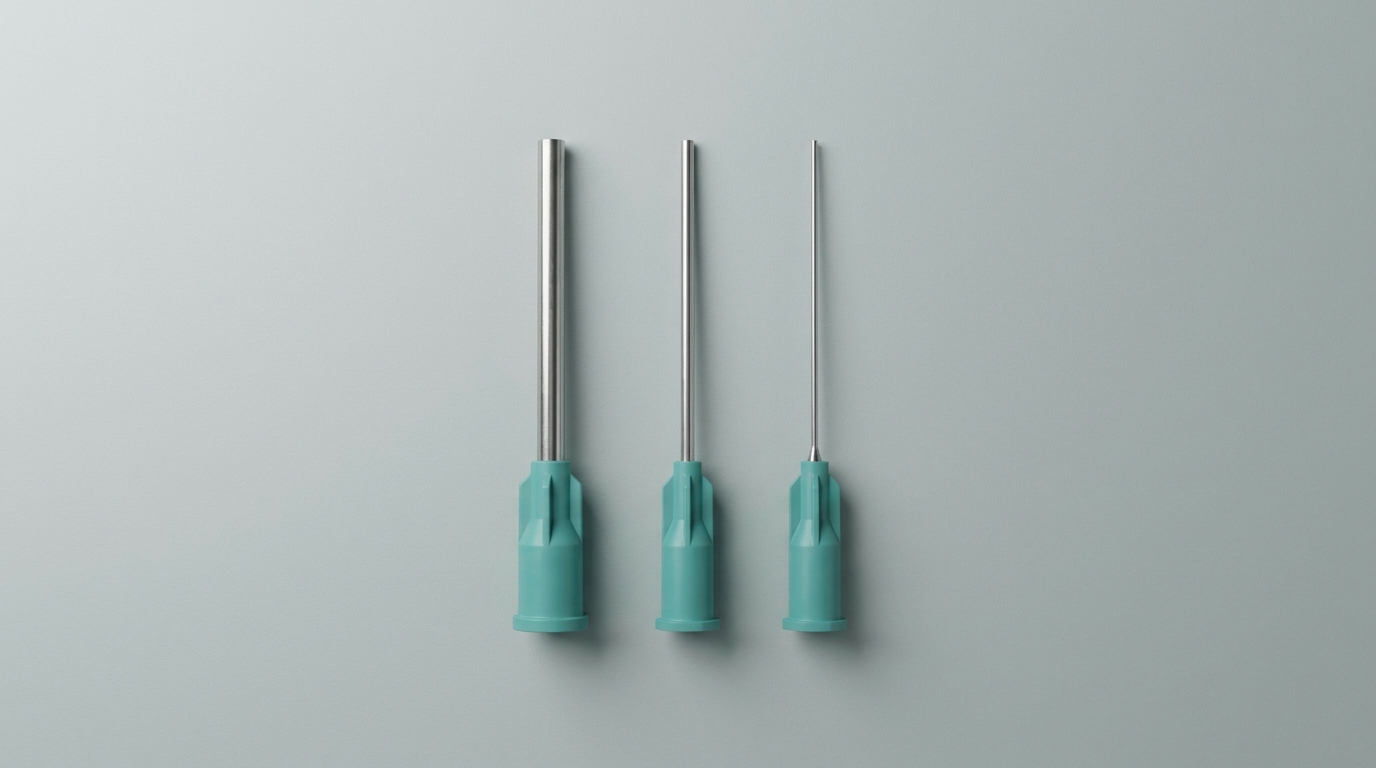
Every syringe is described by three numbers: gauge, needle length and barrel volume. Once you can read them, any product label — ours or anyone else's — makes sense at a glance. Here is what each one means.
Gauge: the thickness of the needle
The gauge (written as a number followed by "G", e.g. 30G) describes the outer diameter of the needle. The rule that trips most people up: the higher the number, the thinner the needle.
| Gauge | Outer diameter | Feel |
|---|---|---|
| 29G | ~0.34 mm | Thickest of the fine gauges — sturdier, faster draw |
| 30G | ~0.31 mm | The everyday middle ground |
| 31G | ~0.26 mm | Thinnest commonly stocked — least felt on the skin |
A thinner needle is generally experienced as more comfortable, but it also draws and dispenses liquid more slowly, and very fine needles flex more easily. That trade-off — comfort versus handling — is why all three gauges remain popular rather than everyone simply choosing the thinnest.
All three fine gauges are available in our sterile 1 mL syringe range, each with the needle permanently attached and supplied in sterile sleeves of 10.
Needle length: millimetres, not gauge
Length is stated separately from gauge, usually in millimetres: 5 mm, 6 mm, 8 mm, 12.7 mm are the common fixed-needle lengths. A "30G × 8 mm" label therefore means: a 0.31 mm-thick needle, 8 mm long.
Length and gauge are independent — a thin needle can be long, a thick needle can be short. When comparing products, always check both numbers rather than assuming one implies the other.
Volume: the barrel, in millilitres
The third number is the barrel capacity: 0.3 mL, 0.5 mL and 1 mL are the standard small-volume sizes. Barrel markings divide that capacity into graduations — on a 1 mL barrel, typically every 0.01 or 0.02 mL.
Two practical points:
- Smaller barrels have finer graduations. If you need to measure small amounts precisely, a 0.3 mL or 0.5 mL barrel is easier to read accurately than a 1 mL barrel.
- U-100 markings are a different scale. Some barrels are marked in "units" (a clinical labelling convention where 100 units = 1 mL) instead of millilitres. Check which scale a syringe uses before comparing capacities.
Reading a full label
Putting it together, a label like "31G × 6 mm, 0.5 mL" reads as: very fine needle (0.26 mm), 6 mm long, on a half-millilitre barrel. That is all there is to it.
Other fittings you will see
Not every syringe has a fixed needle. Luer-lock syringes have a threaded tip that accepts interchangeable needles — the barrel and needle are bought separately, and the needle screws on securely. Blunt fill needles are wide, non-sharp needles used only for drawing liquid out of a vial quickly, never for anything else — many people keep both on hand: a blunt fill needle for drawing, a fine needle for the task itself.
Choosing a complete setup
If you would rather not piece the numbers together yourself, our kit builder walks through the choices — gauge, pack size, and matching supplies like alcohol prep pads and sterile vials — and prices the bundle as you go.
This article is general product information about medical supplies, not medical advice. For guidance on any medical procedure, consult a qualified healthcare professional.
Get your supplies
CE-marked syringes and alcohol prep pads. Shipped from Spain across the EU and UK.